Nutrition and Supplementation
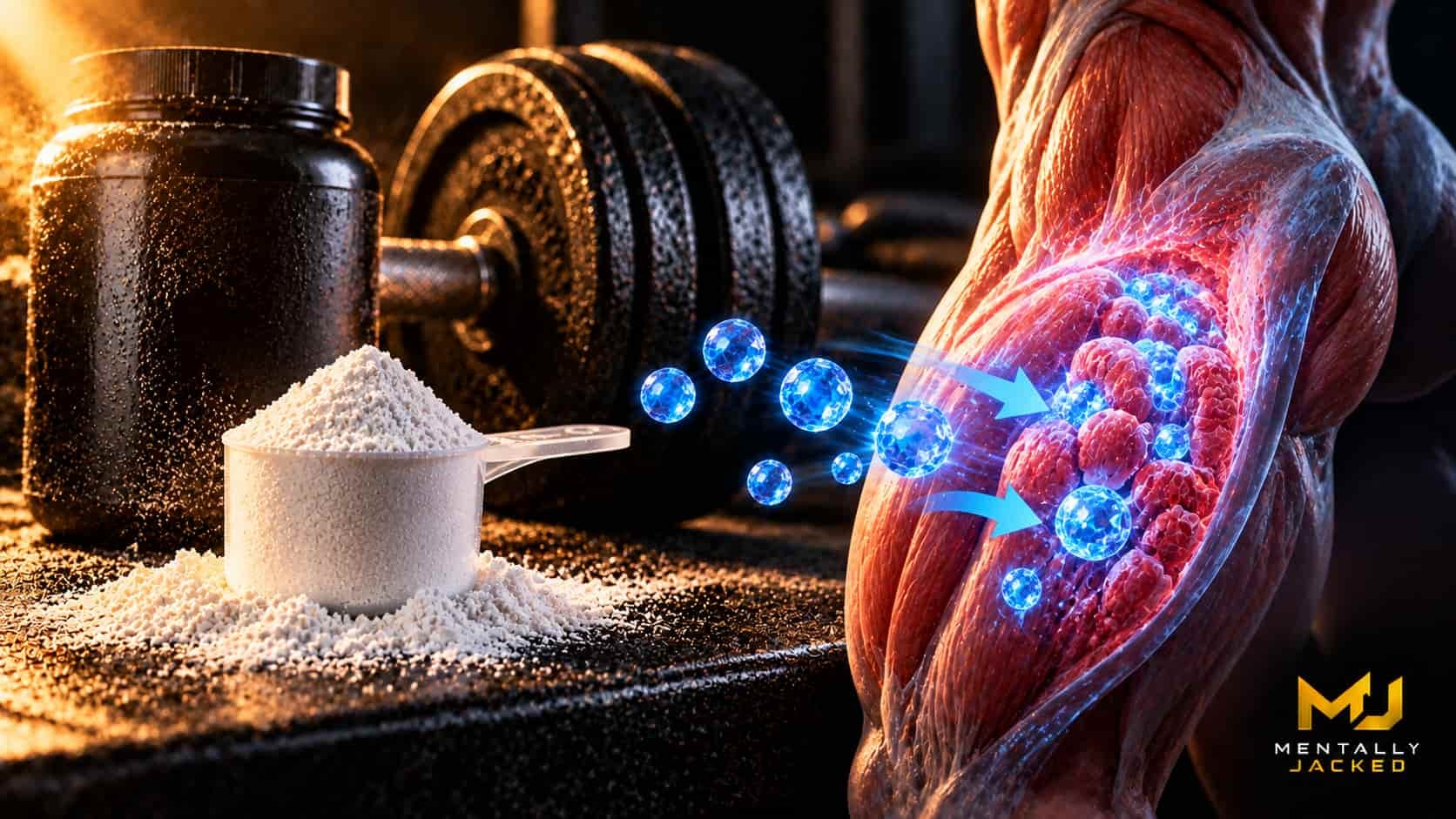
Creatine is the most studied supplement in sport, and the most argued about in gyms. Should you load? Does timing matter? Is HCl better? Does it cause hair loss? Should you cycle off?
Nearly all of these questions have been answered in controlled trials. This is the short, usable version.
Muscle stores creatine as phosphocreatine and uses it to regenerate ATP, the immediate energy source for a heavy set. Supplementing raises muscle creatine stores by roughly 20 to 40 percent, which means a few more reps at a given weight, faster recovery between sets, and slightly better performance in repeated sprints. Over months, those extra reps compound into more muscle and more strength.
The International Society of Sports Nutrition's position stand describes gains in strength and lean mass that are consistent across dozens of trials, and no supplement matches its evidence base. There is also a growing literature on cognition, particularly under sleep deprivation, and on older adults preserving muscle. Those are secondary. The main reason to take it is the gym.
Hultman's 1996 study, the one that established the loading protocol, also showed that 3 grams a day reached the same muscle saturation within about a month. After that point, there is no difference between the two groups.
Loading gets you there faster and gives more stomach upset and a faster jump in water weight. Skipping it costs you three weeks of slightly lower stores. If you have a competition in ten days, load. Otherwise, just take 5 grams every day and stop thinking about it.
Five grams covers almost everyone. The maintenance need is roughly 0.03 grams per kilogram of bodyweight per day, which is about 2.5 grams for an 85 kg person, so 5 grams is already a comfortable margin.
Heavier lifters above 100 kg, and people carrying a lot of muscle, may do slightly better on 5 to 8 grams. There is no benefit to going beyond 10 grams a day, and the excess is excreted.
Vegetarians tend to have lower baseline muscle creatine because dietary creatine comes from meat and fish. They respond more strongly to supplementation, which makes it one of the few supplements with a stronger case on an Indian vegetarian diet than elsewhere.
A small 2013 study by Antonio and Ciccone found a slight edge for taking creatine after training rather than before. The difference was small enough that later reviews treat timing as a minor factor at best.
What does matter is consistency. Creatine works by saturation, not by an acute effect, so a dose taken at breakfast on rest days is as valuable as one taken after a session. Taking it with a meal that contains carbohydrate and protein modestly improves uptake, so with food is a reasonable default.
The old concern that caffeine cancels creatine comes from one 1996 study with an unusual design. Later trials have not supported it. Coffee and creatine in the same day is fine.
Every meaningful trial on creatine used creatine monohydrate. Micronised monohydrate is the same compound ground finer so it dissolves better, which is worth having.
The alternatives:
Look for monohydrate, ideally with the Creapure trademark, which indicates a German-made raw material with tight purity testing. If you want a plain micronised monohydrate, God of Supps stocks one.
Creatine pulls water into muscle cells. Most people gain one to two kilograms in the first weeks. That is intracellular water inside the muscle, not under the skin, and not fat.
Bloating is usually from loading doses, or from mixing 20 grams into too little water. Lower the dose per sitting and it goes.
The hair loss story comes from a single 2009 study in rugby players that found a rise in DHT after loading. It was never replicated, it did not measure hair, and a 2021 review by Antonio and colleagues found no evidence that creatine causes hair loss. If you are already losing hair for genetic reasons, creatine will not be the cause.
There is no evidence that muscle stops responding, or that the body's own production fails to return when you stop. Studies of continuous use over years, including a five-year study at up to 30 grams a day in athletes, found no harm in healthy people.
Kidney markers rise slightly because creatinine rises, which is a measurement artefact rather than damage. If you have existing kidney disease, ask your doctor first. Otherwise, take it every day, indefinitely.
Around a quarter of people see little change. They tend to have high muscle creatine already, usually from a meat-heavy diet, or a muscle fibre profile that stores less. If four to six weeks of 5 grams a day produces no change in reps at a given load, you may be one of them. Nothing to fix, and nothing lost.
To judge the response properly, track a couple of lifts and your weight rather than the mirror. The FFMI calculator and the max muscular potential calculator put any change in lean mass into context, which matters because creatine's water weight can look like muscle in the first month and is not.
Take 5 grams of creatine monohydrate every day, with food, at any time. Skip the loading phase unless you need results within a week. Do not cycle it. Ignore HCl, buffered forms and gummies. Expect one to two kilograms of water in the muscle, not fat, and do not blame it for hair loss.
No. Loading at 20 grams a day for a week reaches saturation faster, but 3 to 5 grams a day gets there within about a month with fewer side effects. Both end in the same place.
Any time, every day. There is a very slight edge for post-workout in one small study, but consistency matters far more than timing. Taking it with a meal is a reasonable default.
No trial has shown creatine HCl outperforms monohydrate at equal doses. Monohydrate is the form used in nearly all the research and costs far less.
No good evidence supports this. The claim rests on one small 2009 study measuring DHT, not hair, that was never replicated.
No. Long-term continuous use in healthy people has been studied for years without harm, and there is no evidence that the body stops responding.
It adds one to two kilograms of water inside muscle cells, which makes muscles look fuller rather than softer. Bloating under the skin usually comes from loading doses or too little water per dose.
This article is educational and is not medical advice. See the medical disclaimer.
Want a programme built around your own numbers?
Work With Dinesh
Nutrition and Supplementation

Nutrition and Supplementation
Nutrition and Supplementation
Newsletter
One email when a new guide, calculator or breakdown goes live. Nothing else.