Hormones and Endocrine Health
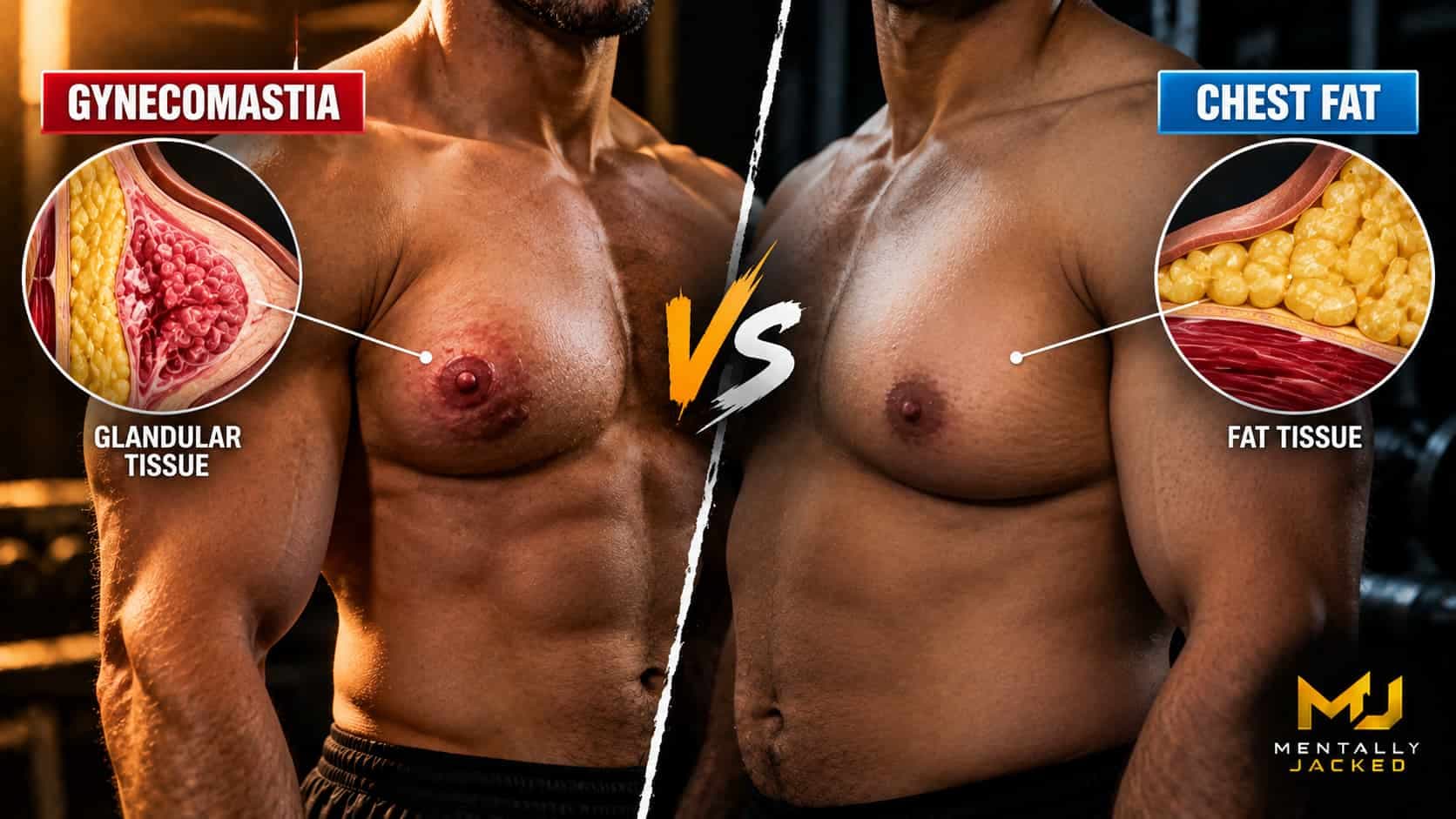
Two men message with the same complaint: puffy nipples, chest that will not tighten, a lump they can feel when they press. One has chest fat that will go with the rest of his body fat. The other has glandular tissue that has been growing for eighteen months and is now past the point where tablets can shrink it. They need opposite advice.
Here is how to tell which one you are before you spend money on either.
Gynecomastia is growth of the male breast gland itself. It sits directly behind the nipple as a firm, rubbery disc, often a couple of centimetres across, and it can be tender. It is driven by hormones.
Pseudogynecomastia is fat over the chest. It is soft, spread across the whole pectoral area rather than concentrated under the nipple, and it tracks total body fat. It is not a hormone problem.
The two can coexist, which is common in overweight men, and that is where the self-check helps.
Lie flat on your back. Place your thumb on one side of the areola and your index finger on the other, and gently bring them together through the tissue.
Tenderness, a nipple that has become more prominent or points slightly downward, and a lump that appeared on one side first all point toward gland. Fat is rarely tender and rarely one-sided. The gynecomastia assessment engine walks through these signs alongside your history and hormone results and gives a probability for each tissue type, which is a better starting point than a mirror.
The male breast gland responds to oestrogen and is held in check by androgens. Anything that raises oestrogen relative to testosterone can start it growing. The common causes:
Testosterone and any compound that aromatises raise oestradiol directly, and gland growth follows in men who are sensitive to it. The higher the dose, the higher the conversion.
Nandrolone and trenbolone are a separate case. They aromatise little but act on the progesterone receptor and can raise prolactin, and both of those stimulate the gland by another route. That is why an aromatase inhibitor often fails to help with gyno from a 19-nor compound.
The instinct to crush oestradiol with a high dose of an aromatase inhibitor causes its own damage to joints, lipids, mood and erections, and does nothing for gland that has already formed. The oestrogen and AI dose calculator exists to prevent that mistake: it models the dose that brings oestradiol into range without dropping it through the floor.
This is the part most articles skip. Gland growth has two phases.
In the first several months, the tissue is proliferating. It is soft, tender and responsive to hormones. Block the oestrogen signal during this phase and much of the tissue regresses.
After roughly twelve months, the tissue becomes fibrous. It hardens, the tenderness fades, and it stops responding to hormonal treatment. Tablets at this stage do very little. Surgery is the only thing that removes it.
So the timeline matters more than the drug. A lump noticed at week three of a cycle and acted on immediately has a very different outlook from one that has been ignored for two years.
Tamoxifen and raloxifene are selective oestrogen receptor modulators. They block the oestrogen receptor in breast tissue while leaving oestradiol in the blood alone, which is why they do not carry the side effects of crashing oestrogen.
None of these are over-the-counter drugs in the sense that matters. They need a prescription, a diagnosis, and someone reading the bloodwork.
For fibrous gland, surgery is the answer, and pretending otherwise wastes a year. The standard procedure removes the gland through a small incision at the edge of the areola, often combined with liposuction of the surrounding fat. Recovery is a few weeks. Results are permanent unless the hormonal cause continues. Cost varies widely across Indian cities and surgeons, and a consultation with a plastic surgeon who does this regularly is worth more than any online estimate.
Fat over the chest goes when body fat goes. There is no exercise that removes it locally. Pressing and flyes build the muscle underneath, which improves the shape once the fat is lower, but they do not burn the fat on top.
A calorie deficit, protein high enough to hold muscle, and patience are the treatment. Chest fat is often the last to go in men, and that is not a hormone problem, it is distribution.
If the self-check points to gland, get these before any treatment:
The bloodwork analyzer reads the oestradiol to testosterone relationship rather than each number alone, which is how the ratio driving the gland becomes visible.
A hard, fixed or irregular lump, one-sided growth in a man over 50, nipple discharge, skin dimpling, or a lump with enlarged lymph nodes in the armpit. Male breast cancer is rare, and every one of those signs is a reason to rule it out quickly.
Firm disc under the nipple is gland, soft spread tissue is fat. Gland responds to tamoxifen or raloxifene in the first several months and becomes surgical after about a year. Fat responds to a deficit and nothing else. Test oestradiol by LC-MS, prolactin and LH before treating, and never crash oestrogen trying to fix gland that has already hardened.
Want a programme built around your own numbers?
Work With Dinesh
Hormones and Endocrine Health
Hormones and Endocrine Health
Hormones and Endocrine Health
Newsletter
One email when a new guide, calculator or breakdown goes live. Nothing else.